

Buying marble
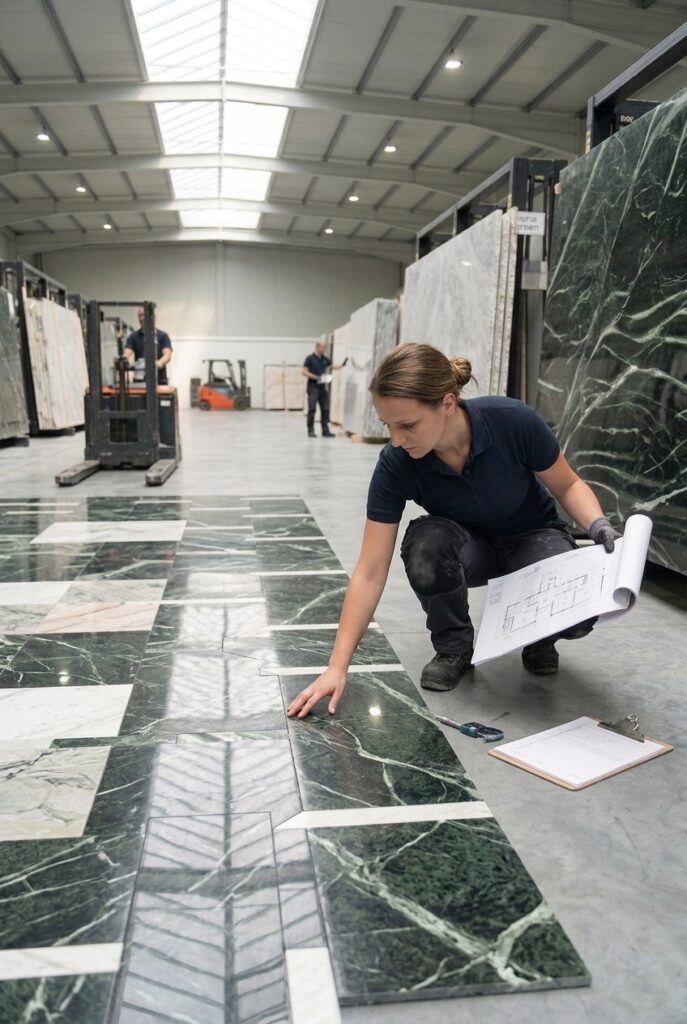
Natural stone varies, so a single small sample never shows the full range. Ask for photos or videos of the actual slabs or blocks reserved for your order, approve a range (light–medium–dark) rather than one piece, and agree in writing on acceptable variation. Before shipment, have the material checked against the approved sample through an independent pre-shipment inspection.
Slabs (usually 2–3 cm thick) are used for countertops, large wall panels, stairs and book-matched features. Tiles (usually 1–2 cm, cut to standard sizes) are more economical for floors and walls. For large projects, cut-to-size pieces made from slabs to your exact drawings reduce waste and installation time.
Grade describes the quality and uniformity of the stone: background colour, veining, spots and natural defects. There is no single international grading standard, and each quarry and supplier uses its own system (e.g. Extra, A, B, Commercial). Always ask the supplier to define their grade with photos, and confirm it in your contract.
It's possible but not guaranteed, because the stone changes as the quarry face advances. For large or phased projects, reserve enough blocks or slabs from the same batch at the start, and ask for them to be stored until needed.
Book-matching means cutting consecutive slabs from the same block and placing them side by side so the veining mirrors like an open book. The slabs must be cut in sequence and numbered at the factory. Check the numbering and do a dry layout or photo layout before installation.
Common issues include cracks and fissures, excessive resin or filler, colour variations outside the agreed range, unwanted spots, uneven polish, thickness differences, chipped edges and warped slabs. Some natural features are normal; the key is agreeing in advance what is acceptable and checking it before shipment. Learn more about our inspection services.
Yes. Many marbles are reinforced with resin and a fibreglass mesh on the back to strengthen natural fissures and reduce breakage during handling. It is standard practice. What matters is that the resin is applied properly and isn't hiding structural cracks on the visible face.
For calibrated tiles and cut-to-size pieces, tolerances are usually around ±1 mm. For slabs, ±1–2 mm is common. Larger differences cause problems during installation, especially on floors. Agree on tolerances in your order and check them before shipment.
In the EU, marble products for construction must carry CE marking under the Construction Products Regulation, according to standards such as EN 1469 (slabs for cladding), EN 12057 (modular tiles) and EN 12058 (slabs for floors and stairs). Ask the supplier for the Declaration of Performance and technical data (absorption, flexural strength, density, frost resistance).
Buying direct from the quarry or factory usually gives a better price and a wider selection, but requires knowledge of the material, the market and the export process. Distributors offer convenience and local stock at a higher price. Many international buyers use a local representative to buy direct with less risk.
Prices vary with the type and rarity of the stone, the grade, the size and quality of the slabs, the thickness, the finish, the processing, and whether resin or mesh is included. Two suppliers may use the same name for very different qualities. Always compare quotes based on photos of the actual material and detailed specifications, not just the name, and inspect the material before you buy.
A common structure is a deposit (often 30–50%) with the order and the balance before loading or against shipping documents. Ideally, release the final payment only after the material has passed an independent pre-shipment inspection.
Stock slabs can ship within a few weeks. Cut-to-size projects typically take 4–12 weeks depending on volume and complexity, plus transit time. Large projects should allow extra time for block selection, sample approval and quality checks.
Slabs are usually shipped in strong wooden A-frames or bundles. Tiles and cut-to-size pieces go in wooden crates with protective layers between the pieces. Everything must be properly fastened inside the container. Poor packing is one of the main causes of breakage.
FOB (Free on Board) and CIF (Cost, Insurance and Freight) are the most common. With FOB, you arrange the sea freight and insurance yourself; with CIF, the supplier does. EXW (Ex Works) puts all transport responsibility on the buyer. Make sure you understand who is responsible for what, and who is liable if goods are damaged.
Document everything immediately with photos and videos while unloading, note the damage on the delivery documents, and notify the supplier and insurer in writing. Resolving claims across borders is slow and difficult, which is why checking the material and the loading before shipment is the most effective protection. See our inspection services.
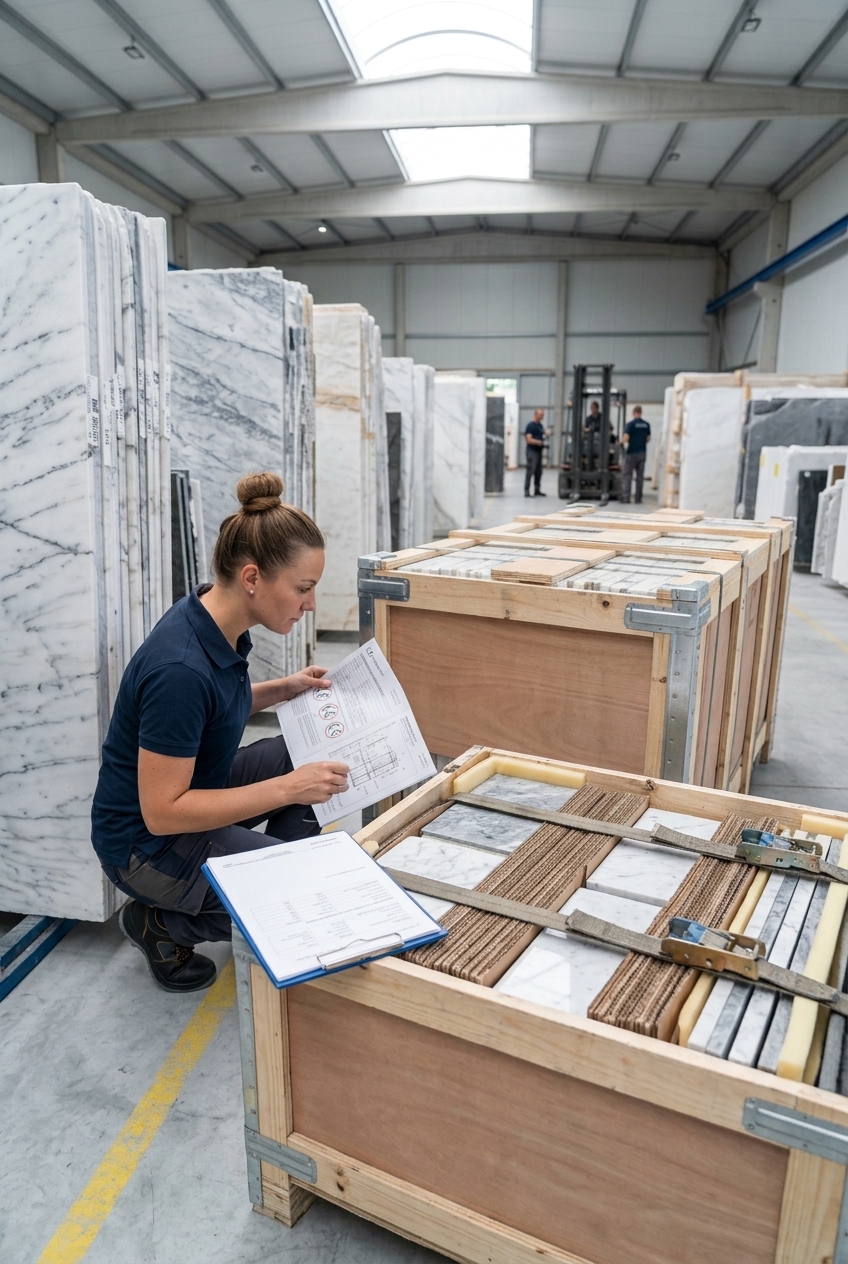
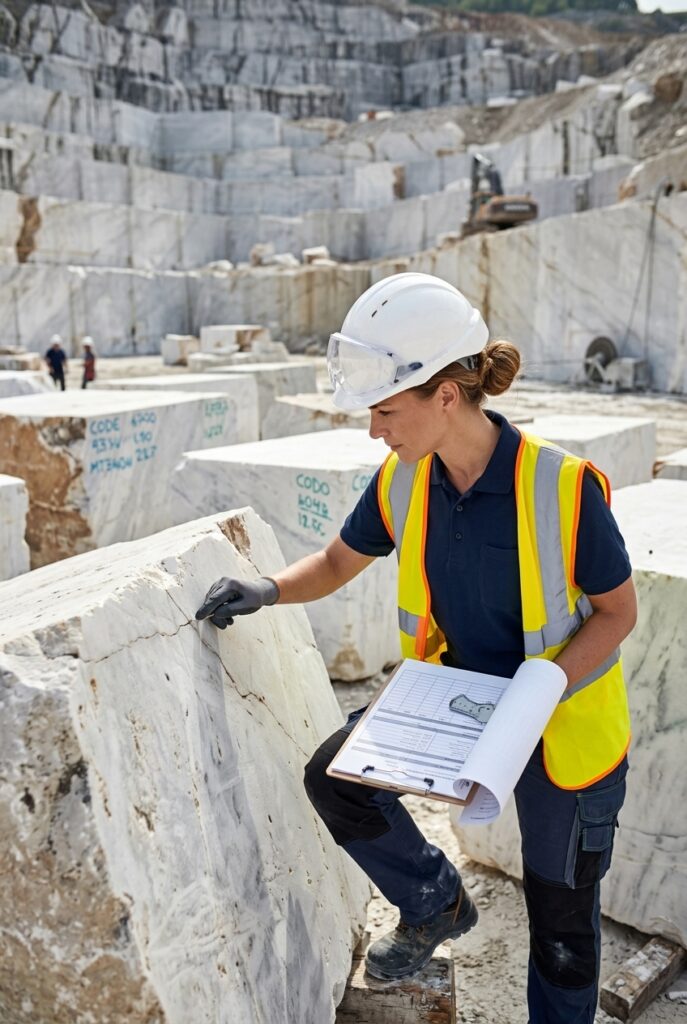
Typically 10–15% extra for tiles and simple layouts, and 15–20% or more for slabs, complex patterns, book-matching or diagonal layouts. Ordering extra from the same batch also ensures matching material for future repairs.
A standard 20-foot container usually carries around 20–25 tonnes. For 2 cm slabs, that's roughly 350–450 m² depending on the marble's density and slab sizes. 3 cm slabs fit proportionally less. Your supplier should give you an exact packing list.
Yes, and it's highly recommended for large orders. Seeing the blocks and slabs in person helps you understand the real colour and variation. If you can't travel, a trusted local representative can visit, select and photograph material on your behalf.
Typically: commercial invoice, packing list (with slab numbers and dimensions), bill of lading, certificate of origin, and, where required, phytosanitary or fumigation certificates for the wooden packaging (ISPM 15), plus CE documentation and technical data sheets.
About marble
Marble is a natural metamorphic rock formed when limestone is exposed to intense heat and pressure deep within the Earth. The original calcite grains recrystallise into a dense, interlocking crystalline structure, which gives marble its characteristic glow and its ability to take a high polish.
It begins on the floor of ancient seas, where shells and skeletons of marine organisms build up layers of limestone. Over millions of years, tectonic movements push the limestone deep underground, where heat and pressure transform it into marble. Uplift and erosion eventually bring it back to the surface, where it can be quarried.
Pure marble is white. Colours and veins come from other minerals present in the original limestone: iron oxides create pinks, reds and yellows, graphite creates grey and black veins, and serpentine or chlorite create greens. That's why no two slabs are ever exactly the same, even from the same block.
Calcitic marble is made mainly of calcite (calcium carbonate), while dolomitic marble contains dolomite (calcium magnesium carbonate). Dolomitic marbles, such as Thassos, are generally harder, denser and somewhat more resistant to etching.
Italy (Carrara), Greece, Turkey, Spain, Portugal and India are among the world's most famous producers. Greece has been quarrying marble for more than 2,500 years, from the Parthenon to modern landmark projects around the world. Greek marbles such as Thassos, Volakas and Pirgon are known for their bright white backgrounds, fine crystalline structure and high density.
Granite is an igneous rock made mainly of quartz and feldspar. It is harder (about 6–7 on the Mohs scale versus 3–4 for marble) and more resistant to scratches, heat and acids. Marble is softer but prized for its elegant veining and its luminous, classic appearance.
No. Quartz countertops are an engineered product made of crushed quartz bound with resins and pigments, often designed to imitate marble. They are very low-maintenance, but they are not natural stone and can be damaged by high heat or prolonged UV exposure.
Quartzite is a metamorphic rock formed from sandstone and is much harder than marble. Some white quartzites look very similar to marble, and they are sometimes mislabelled. A simple scratch test with a knife or a glass edge helps tell them apart: quartzite will not scratch, marble will.
Real marble feels cool to the touch, shows natural, irregular veining that runs through the whole thickness of the stone, and can be scratched with a steel knife. A drop of vinegar on a hidden spot will make real marble fizz slightly. Engineered stone and porcelain usually show repeating patterns and printed veins only on the surface.
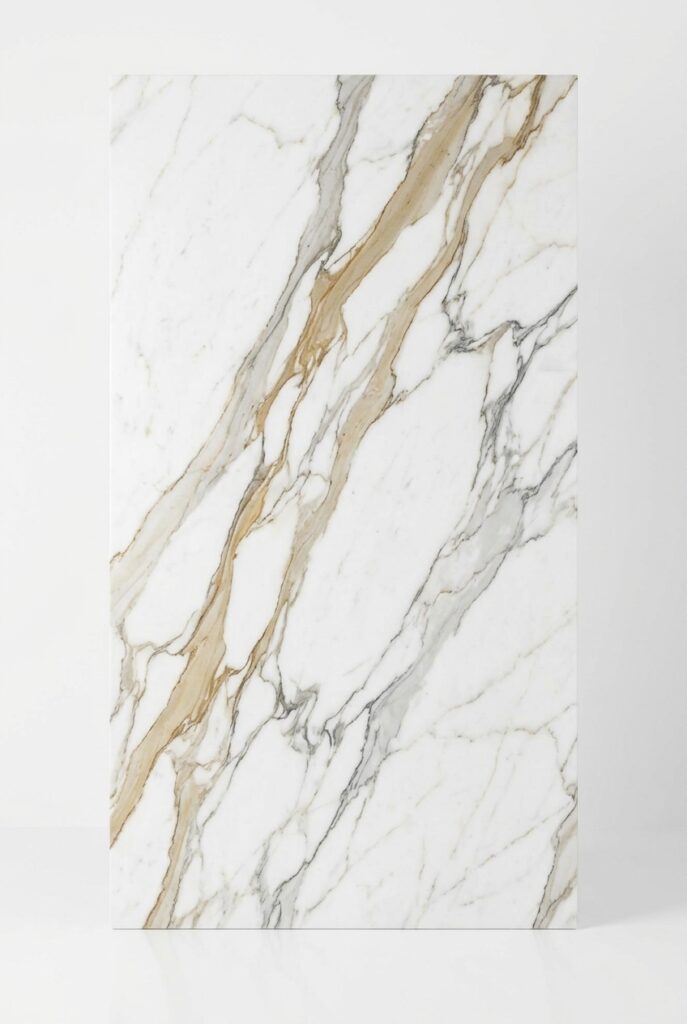
These are Italian white marbles. Carrara has a light grey background with soft, fine grey veining. Statuario has a brighter white background with bold grey veins. Calacatta is the rarest, with a white background and dramatic, thick veins, often with gold or beige tones.
Finishes, use & care
Architects and designers are moving away from high-gloss polish towards softer, more tactile surfaces: honed, satin, brushed and leathered finishes. Polished marble is still used for dramatic statement pieces, while textured surfaces such as fluted, ribbed and 3D-carved designs are increasingly used for walls, kitchen islands and furniture.
A leathered (or brushed) finish is created with diamond-tipped brushes that soften the surface and follow its natural texture, leaving a slightly undulating feel with a low, satin sheen. It hides fingerprints, water marks and light etching better than polish, and it brings out depth of colour, especially in darker marbles.
Fluted (also called ribbed or cannelé) marble has parallel grooves or rounded ridges cut into its surface, creating a play of light and shadow. It is one of the strongest trends in interiors, used on kitchen islands, bathroom vanities, feature walls, reception desks and furniture. Fluting requires extra machining, so it costs more than a flat surface, and the grooves need a little more care when cleaning.
The bamboo finish is a variation of fluting where the grooves vary in width and depth, recalling the stems of bamboo. It is produced on profiling or CNC machines and highlights the stone's natural veining. Italian producer Antolini, for example, presented a Bamboo finish as part of its textures collection. It is mainly used for wall cladding, kitchen islands and furniture fronts rather than for floors or work surfaces.
These are marble tiles or modules machined with CNC technology into three-dimensional patterns: waves, geometric reliefs, pleats or architectural motifs. Companies such as Lithos Design produce collections of carved marble wall coverings in standard modules (for example 60 × 60 or 120 × 60 cm, 2 cm thick). They are used as feature walls in lobbies, hotels, bathrooms and retail spaces, where changing light brings the surface to life.
Honeycomb panels are made of a thin layer of natural marble bonded to a lightweight aluminium honeycomb core. Typical panels are 15–25 mm thick in total and weigh around 16 kg/m², roughly 70–80% lighter than solid stone (a 3 cm marble slab weighs about 80 kg/m²). They allow very large formats, are more resistant to impact and breakage, and reduce the load on the building structure.
They are ideal wherever weight matters: building façades and ventilated façade systems, high-rise interiors, ceilings, lift cabins, yachts and cruise ships, prefabricated bathroom pods, furniture and exhibition stands. Large residential and hotel projects, such as luxury towers in Miami and the Middle East, use them for exterior cladding with natural marble.
Yes. The visible face is genuine natural stone, so it shows real veining and can be book-matched. Because many thin panels are cut from the same slab, colour consistency across large areas can actually be better than with solid stone. Quality depends on the bonding: check flatness, bond strength, edge finishing and that the stone layer has no hidden cracks. For large orders, an independent pre-shipment inspection is strongly recommended.
Ultra-thin veneers are sheets of real stone just a few millimetres thick, or even around 1–2 mm, backed with fibreglass, resin or fabric. They are light and some can bend around curved surfaces such as columns and rounded furniture. They are used in interiors, retail and furniture where full-thickness stone would be too heavy or impossible to shape.
Yes. When cut very thin, some marbles, and especially onyx, let light through. For backlit walls, counters and bars, the stone is cut to about 3–5 mm and often laminated to glass for strength, then lit from behind with LED panels designed to spread light evenly. Onyx is the most popular choice because its bands and colours glow dramatically when lit.
A waterjet uses a very high-pressure stream of water mixed with abrasive to cut stone with great precision. It makes it possible to create complex shapes, curves, inlays, medallions and mosaics combining different marbles, which would be very difficult to achieve by hand. Combined with CNC machining, it has opened up almost unlimited design possibilities.
Conventional sealers protect against stains but not against etching from acids. Some producers now offer factory-applied protective treatments that also resist etching. Antolini's Azerocare, for example, is applied to polished slabs at the factory and is designed to protect against acidic substances such as wine, lemon and vinegar, provided a proper maintenance routine is followed. Ask your supplier whether such a treatment is available and how it affects the warranty.
Alongside timeless white marbles, current interiors favour warmer tones: cream, beige, taupe, travertine and honey-coloured stones. Deep greens, burgundy and blue marbles are used as bold accents, and dark marbles with gold or white veining remain popular for dramatic spaces. Pure white marbles, such as many Greek varieties, are still the first choice for bright, minimalist and classic projects.
Marble is a natural material that needs no chemical manufacturing, lasts for generations and can be restored rather than replaced, which makes it a strong long-term choice. Its main environmental costs are quarrying, processing and transport. Choosing stone from quarries with good environmental practices, using offcuts for smaller products, and recomposed stone made from marble waste all help reduce the footprint.
Yes, and it's a popular choice for shower walls and vanities. Use honed or textured rather than polished surfaces, seal the stone properly, and keep in mind that grooves and reliefs collect soap and limescale more easily, so regular cleaning with a pH-neutral cleaner and a soft brush is important. Avoid acidic limescale removers.
A polished finish gives a glossy surface and highlights the colour and veining, and is ideal for walls, lobbies and low-traffic areas. A honed finish is matte and smooth, more slip-resistant, and better at hiding wear and etching, so it is preferable for floors, kitchens and bathrooms. Other options include brushed, leathered and sandblasted finishes.
Yes, if you accept its natural character. Marble resists heat well and is beautiful, but acidic foods and drinks (lemon, vinegar, wine, tomato) can etch it, and it can stain if left unsealed. Many people love the patina it develops over time. A honed finish hides wear better than a polished one.
Yes. Marble has been used outdoors for millennia, from ancient temples to modern façades. Outdoors, polished surfaces gradually lose their gloss due to weathering, so honed, brushed or textured finishes are usually preferred. In cold climates, choose a dense, low-absorption marble to resist freeze–thaw cycles.
Polished marble can be slippery, especially when wet. For floors, bathrooms and outdoor areas, honed, brushed, sandblasted or bush-hammered finishes provide much better grip.
With proper care, marble can last for centuries. Ancient monuments like the Parthenon show it can survive for thousands of years. In homes, a marble floor or countertop can easily outlast the building's other finishes, and worn surfaces can be re-honed and re-polished to look new.
Slabs are typically 2 cm or 3 cm thick. Tiles are usually 1–2 cm. For countertops, 3 cm is common, or 2 cm with a thicker built-up edge. Exterior cladding often uses 3 cm or more, depending on the fixing system.
Use warm water and a pH-neutral cleaner made for natural stone, with a soft cloth or mop. Avoid vinegar, lemon, bleach, ammonia and abrasive cleaners, as they can damage the surface. Wipe spills quickly, especially acidic ones.
A stain is a darker mark caused by a liquid being absorbed into the stone, such as oil, coffee or wine. An etch is a dull, lighter mark where acid has chemically corroded the surface. Stains can often be drawn out with a poultice; etches need re-honing or polishing.
Most marble benefits from a penetrating sealer, especially in kitchens, bathrooms and floors. Sealing reduces staining but does not prevent etching. Depending on use and the stone's porosity, resealing every 1–3 years is typical. A simple test: if water darkens the stone within a few minutes, it's time to reseal.
Yes. Professional stone restorers can grind, hone and re-polish marble to remove scratches, etching and wear, bringing it back to its original look. This is one of the big advantages of natural stone over many other materials.